Hugh Hamilton Lindsay

A dominating presence in the opening chapters of The Scramble for China is Hugh Hamilton Lindsay (1802–1881), probably the first Briton to visit Shanghai, in 1832 on board the Lord Amherst. It was frustrating to write about a man of whom no images whatsoever appeared to have survived. At a late stage, I was alerted to a watercolour in the Chater Collection of the Hongkong & Shanghai Bank, which seems to show him ‘leaving Canton in a fast-boat’, according to a description written on the painting. It is an atmospheric image, and I used it in the book, but the man shown is fairly indistinct.
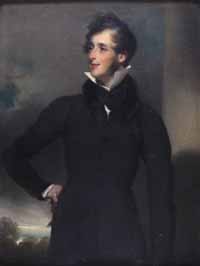
Hugh Hamiton LIndsay, painted by George Chinnery, copyright Sir W. Young.

Hugh Hamiton LIndsay, painted by George Chinnery, copyright Sir W. Young.

In September 2011 I fleshed out Lindsay’s life and career more fully in a lecture to the Royal Historical Society, now published in the Society’s Transactions. Afterwards, as a result of the publicity, I received an email asking if I would be interested in seeing a portrait of the man, painted by the great India and China coast artist, George Chinnery. Within a few days I was holding this delightful small painting in my office in Bristol.

Lindsay had no children, but the owner was a descendant on his sister’s side. It shows a man perhaps not yet 30, in a romantic style. It fits very well with descriptions of LIndsay in the journal letters of the American Macao resident Harriet, Low, ‘droll’, handsome, ‘always ready, for adventures of any kind’. Lindsay commissioned the famous drawing of Karl Gützlaff in Chinese clothing by Chinnery, which is best known in the form of a print, and it made perfect sense to find that the artist had painted the Scotsman as well.

So there he is, at last: Hugh Hamilton Lindsay, would-be Sinologist, restless traveller, warmonger, Member of Parliament, angry young man, embittered old China hand. He railed successively against the East India Company which employed him until 1832, the Qing empire which thwarted his ambition in China, the British state which did not follow a ‘forward’ enough policy there and, later, he fought with ‘Rajah’ James Brooke over concessions in Borneo. Most of that story was yet to come when George Chinnery captured the spirit of this nonetheless charming adventurer, sometime around 1830, in sleepy Macao.
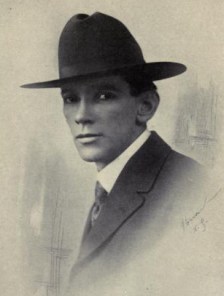
Tex O’Reilly, Shanghai Policeman

O'ReillyTwo correspondents recently drew my attention to a obscure Shanghai police memoir I had not heard of: Roving and Fighting: Adventures under Four Flags (1918). In this and his later Born to Raise Hell Tex’ O’Reilly, also known as ‘Major’ Edward S. O’Reilly (1880-1946), recounts a mercenary life in Asia and central America at the turn of the nineteenth and twnetieth centuries. In between his military escapades (one of those ‘four flags’ — China’s — employed him for but a few weeks at most) he was a language teacher in Japan, and a policeman in the International settlement at Shanghai.
I have no record of his police service, which in his telling lasted ten months in 1901, but short-serving men leave fewer records, and often do not appear in annually published staff lists. The yarn deals with much of the predictable stuff of salacious exposes and popular fictions of the coast, but also has a ring of truth to some of it. O’Reilly was later a journalist, so knew how to mix the two. Although he delivers as his own experience an account of dealing with the settlement’s Wheelbarrow riots — which actually took place in 1897 — he later names a man who left the police with him to serve as a bodyguard for a local Chinese official, and a man of the same surname did actually leave the Shanghai Municipal Police in 1902. A ‘T.E. Reilly’ sailed out of Shanghai for Nagasaki, as Tex says he did, on 26 February 1902. O’Reilly made his name later in the Mexican revolution and as a journalist, but there seems to be no reason to doubt he was for some short time a Shanghai policeman, despite his reputation as a spinner of tall, tall tales.

Signing off on the ‘unequal treaties’

U.S. and U.K. representatives sign new equal treaties with the ROC in 1943. (CNA 05/20/1943)

It is seventy years ago this week that British and Chinese diplomats in China’s war-time capital Chongqing (Chungking), signed an agreement that abolished the privileges and rights in China that had been acquired by the British through and since the 1842 Treaty of Nanjing. The process of the securing of those privileges is the major theme of The Scramble for China.

The new treaty was ratified in a brief ceremony in Chongqing on 20 May 1943. It was partly academic at the time, for many of those British possessions and interests not already surrendered to the Chinese government since early 1927 — the international settlements at Shanghai and Xiamen (Amoy), and the British concession at Tianjni (Tientsin) — were largely under the control of the Japanese. But the new agreement was symbolically hugely important, and was accompanied by a similar US-China treaty. Such symbolism was also not lost on the Japanese occupiers, who also arranged for the Shanghai international settlement to be surrendered to China on 1 August 1943, although in that case to the collaborationst government of Wang Jingwei.

The 1943 Anglo-Chinese treaty is rather less well-known than the 1842 Nanjing Treaty, or the 1858 Treaty of Tianjin, the founding documents of the system of ‘treaty ports’ and concessions in China, not least because it was secured by the Nationalist Government of the Guomindang, and so sits awkwardly alongside narratives which accord the leading role in the rolling back of foreign imperialism in China to the Chinese Communist Party.

North China Herald Online … at last

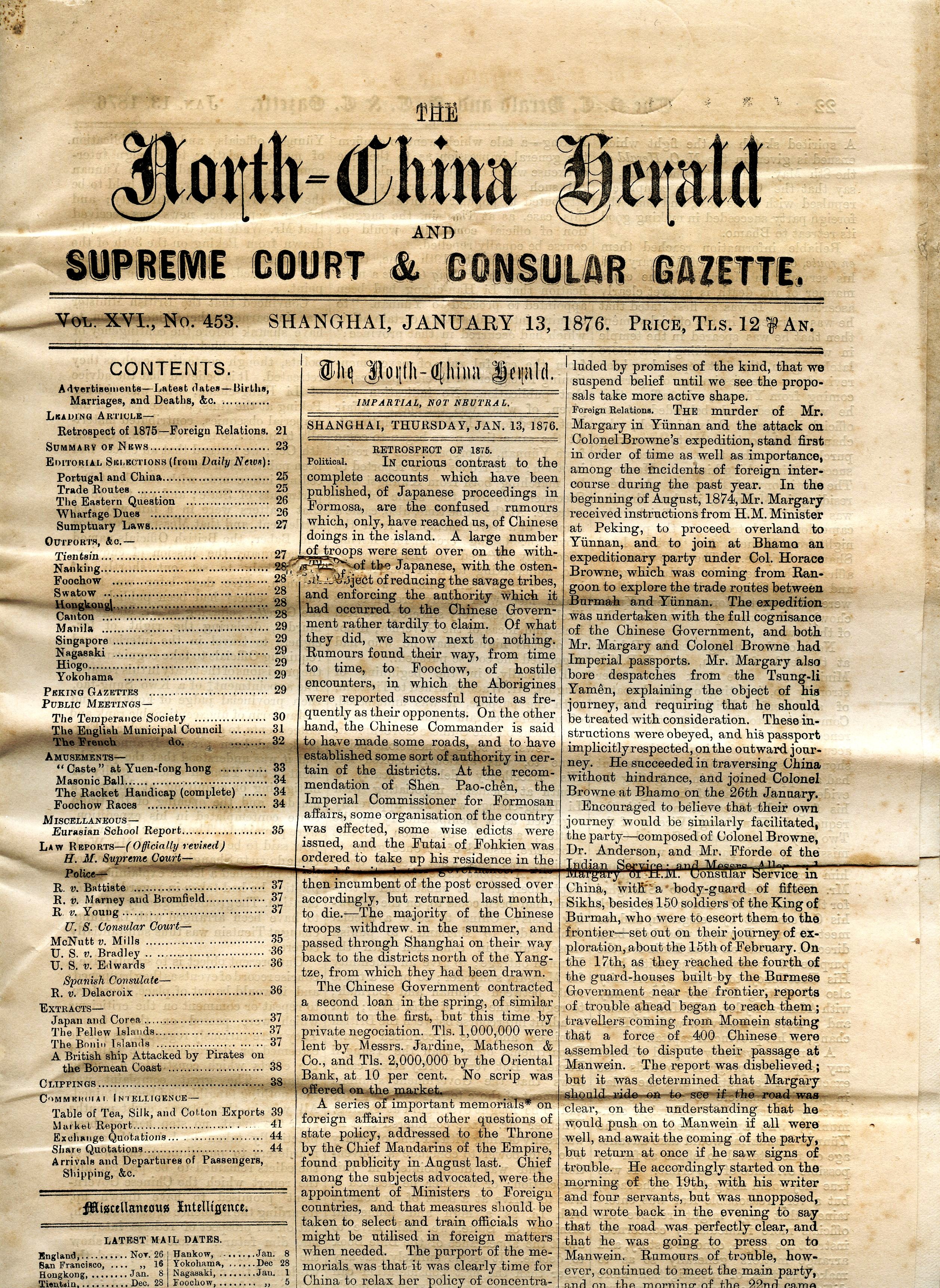
I have been making use of Shanghai’s North China Herald newspaper (1850-1941) for over years, mainly in the shape of the steadily crumbling copies in the library of the School of Oriental and African Studies. Recently I have been working with the Leiden publisher Brill, who have had this set of the paper scanned, and are preparing a full-text searchable edition. Pester your library for it.

The Herald (北華捷報) predated the North China Daily News 字林西報by 14 years, but thereafter became the weekly edition of that daily, the biggest selling English-language newspaper in China. It was edited by, amongst others, R. W. “Bob” Little, brother of the more famous Archibald John Little, who pioneered steam navigation of the Upper Yangzi river. The Little family letters were an important source in my book The Scramble for China.

All human life is here in the Herald, and death too. There are court cases and gossip; lists of ships’ passengers and the racing results: polemical editorials and verse; news of ‘outrages’ and ‘outport’ parties; cartoons and inquests, and more.

Talk in Shanghai, 14th April 2012

I’ll be in Shanghai in mid-April, talking to the Royal Asiatic Society China at the Tavern, Radisson Plaza Xingguo Hotel 78 Xing Guo Road, Shanghai 兴国宾馆 上海市兴国路78号. Title: ‘Britain, China and India 1830s – 1947’. For more information and booking see here.